Highline Vision Center & Highline Center For Vision Performance
720-870-2828

Myopia / Nearsightedness in Kids: A Presentation

Recently, Dr. Jeri gave a presentation about Myopia in kids. Learn why myopia (commonly called “nearsightedness”) is increasing so much and about groundbreaking treatments available.

Below is a transcript of the presentation by Dr. Jeri Schneebeck, O.D., F.C.O.V.D.:

Thanks for joining me this evening, for this presentation.  It’s about myopia management and our goal is with that to significantly slow the progression of nearsightedness. At Highline, we’ve always been in the forefront of trying to slow the progression of nearsightedness in our patients. Tonight, we’re going to talk about why this is so important, and review the variety of technologies that are available, and introduce a new lens that’s just been released.

WHAT IS MYOPIA OR NEARSIGHTEDNESS?

It’s the inability to see clearly at distance. On the left, the picture shows emmetropia, which is when there is no refractive error. The light rays enter the eye and automatically focus on the retina. With the myopic eye, on the right, you can see that the light rays enter the eye and focus in front of the retina leaving distance objects blurry.

CAUSES OF MYOPIA

Genetics is one of the things that’s very important. So, the likelihood of a child developing myopia increases to 50% when both parents have myopia, 33% when one parent has myopia, and 25% when neither parent has myopia. We also know that lifestyle is a big piece of developing myopia.

Research shows that modern lifestyles may influence the development. Insufficient time spent outdoors is believed to be one reason. Currently our children spend an average of 30 minutes a day outside. We also believe that prolonged time spent reading and playing and working on digital devices is a component of it. The same children who are only spending 30 minutes a day outside are spending an average of 7 hours a day in front of electronics. The statistics show that this may have serious consequences on their health and well-being. When our doctors are counseling patients, we recommend 2 hours of outdoor play daily to reduce the potential of developing myopia.

Think of the other benefits, more outdoor play can lessen obesity and lower body mass index, improve fitness, grows motor skills, muscle strength, reduced incidence of depression, improved relationships with peers and parents, and it develops an appreciation for the environment.

Myopia is becoming more widespread and more severe than ever. In the early 70s, only 25% of Americans were nearsighted. Today, more than 40% of Americans are nearsighted. That number’s increasing at an alarming rate, especially among school-aged children. By 2050, 58% of the North American population is predicted to be nearsighted.

LONG TERM IMPLICATIONS OF MYOPIA

Myopia is measured in quarter diopter steps. For every full diopter of increase in myopia, there’s a 30% increased risk of retinal detachment, and a 67% increased risk of myopic maculopathy. In addition to these health implications, if we can keep a child’s myopic prescription lowered, when they get old enough, their candidacy for refractive surgery, LASIK, or PRK may be improved, and the results may be better. Leaving myopia unmanaged may contribute to severe eye health complications and sight threatening conditions later in life.

MYOPIA RISK ASSESSMENT

You’ll notice that every single one of these risk levels has that recommendation for limiting screen time, limiting close work outside of school, and encouraging at least 2 hours of outdoor play per day. How do we know if a child’s in need a myopia management program?

LOW RISK

Low risk is if they’re a little bit farsighted, a little bit more than +.75 (farsightedness) at age 6 or younger, is what that tells us that there’s going to be a bit less of a risk for them becoming nearsighted.

Ideally a child is slightly farsighted, or hyperopic is the other word for that, which does then bring less risk for becoming myopic.

MEDIUM RISK

A medium risk happens when, even if they’re just a little bit lower than +.75 at age 6 or younger. At that age, if we’re not seeing nearsightedness yet, but we’re seeing a zero prescription, you would think that would be great, but, in reality, it does put them at a medium risk of developing myopia later. So, we watch for changes in their prescription over a short period of time at that time. It’s one reason why we recommend that school-aged children have their eyes checked every year.

HIGH RISK

The high risk comes if there’s any myopia at all confirmed in any pre-school or school-aged child. If we aren’t going to immediately enroll them in a myopia management program, we want to watch them extremely carefully at this point. We’re going to follow them every three to six months. And the ideal is, if they are changing at all, if their myopia is increasing at all, we want to get them going in a myopia management program.

MYOPIA MANAGEMENT TODAY – FOR THE FUTURE

For children who begin a myopia management program (the earlier, the better), their vision will not only be corrected today for distance, but the progression of myopia over the child’s growing years may be slowed. So, it will minimize the long-term impact of myopia:

  • Reduced eyeball elongation. Remember that one of the reasons for myopia is elongated eye.
  • We slow the progression of nearsightedness, and
  • We have a potential reduction in the health complications found more frequently in myopic patients.

Some of the methods we use at Highline to slow myopia progression.

  • Multifocal or anti-fatigue design spectacle lenses. These are used for children too young to wear contact lenses.
  • We use very low dose atropine drops, or can do that as a method to try to slow myopia progression.
  • CRT lenses. They are contact lenses called corneal refractive therapy, and we’ll go into those a little bit more and explain how that type of a contact lens works.
  • And then finally, we will discuss the MiSight® daily disposable soft contacts, which is the new lens just released with some really nice research behind it.

MULTIFOCAL OR ANTI-FATIGUE DESIGN SPECTACLES

For many years, multifocals have been the only option for trying to control myopia progression with spectacles. There are some new spectacle designs being released, being developed, right now that have the peripheral retinal defocus properties to slow myopia progression.

That’s a mouthful, I know. So, without going into too much detail, all myopia control modalities operate by creating a defocus on the retinal periphery while simultaneously providing clear central vision. From 2010 to the present there’s been a shift toward developing myopia management devices that alter periphery retinal defocus based on the landmark studies that found that the peripheral retina had a significant role in refractive error development.

You’ll hear me say that the number of our modalities is kind of the ultimate goal to create a clear central image at distance while creating a peripheral retinal defocus. That helps to stop the elongation of the eye.

LOW DOSE ATROPINE DROPS

These are used one drop in each eye before bed. They’ve been shown to significantly decrease myopia progression in children within a year. And, they can be used in conjunction with some of our other myopia control measures, so that’s a nice. If you have somebody you really feel is progressing rapidly, we may want to use more than just one method to try to control that.

They’re ordered from a compounding pharmacy with a cost of about $45 a month, so, they’re not real expensive. And, the disadvantages are this is a prescription medication and it does take motivation of parents and child to get the drops in nightly. Again, the atropine drops work by creating peripheral retinal defocus. So, again, that’s shown to slow that elongation of the eye that causes progressive myopia.

Benefits of choosing a contact lens-based myopia management approach

  • The vision is corrected for daily actives such as school and sports.
  • It’s thought to be a more comfortable experience for children versus wearing glasses, there’s some studies about self-esteem and so forth with contact lens wear versus wearing glasses.
  • There are no glasses to lose or break, although, I will say that “back up glasses” are always recommended for contact lens wearers. In the event that they can’t wear their contacts a given day due to an eye infection or whatever reason. We do recommend that with these contact lens modalities that we’re going to be talking about with that do the control of myopia, that they are worn a minimum of six days a week. So, it is a commitment to wearing the contact lenses.
  • Contacts accommodate a more active lifestyle versus wearing glasses. So, in this short term, the benefits of a contact lens-based myopia manage approach may look very much like correcting vision with traditional contacts. However, the design of all of these lenses is very different from a standard contact lens.

CRT LENSES – CORNEAL REFRACTIVE THERAPY

The first contact lens that we’ll talk about are the CRT lenses. That stands for corneal refractive therapy. They’re a rigid gas permeable lens that’s worn overnight while you’re sleeping. They work by gently reshaping the curvature of the cornea while you sleep. Then you remove them upon awaking and your vision is corrected throughout the day.

So, it’s a great choice for athletes, that’s why I’ve put these pictures up here. For swimmers especially, because you really should not be wearing soft contact lenses in a swimming pool at all. These are great for athletes who may lose or get daily wear contacts dirty and it may also be the lens of choice for those having moderate amounts of astigmatism and some of our other choices do not correct for astigmatism. And again, this lens design creates the peripheral defocus on that retina that’s needed to slow the progression of myopia.

MISIGHT DAILY CONTACT LENS

They’ve called it the Brilliant Futures Myopia Management Program. It’s a comprehensive approach built around that MiSight lens. I’m going to give you a little more information about that lens tonight. Because then the other things that we’d talked about, just because they were just released, and they have ten years of research to support their effectiveness.

Many studies involving contact lenses are retrospective. They use existing data that’s been collected from the eye exams that have already been done. And, they use that information to put together the success of the contact lens. MiSight lenses were studied for ten solid years before they were brought to market with randomized double blind placebo-controlled studies that are the gold standard in research.

Our program fee includes all of these things:

  • An annual supply of MiSight daily disposable lenses, they’re single use lenses, you put them in in the morning, you throw them away at night. They’re considered the healthiest alternative for children to wear.
  • Free shipping and free returns whether the prescription changes or not.
  • App: There’s a very helpful app that will help with appointment reminders, payment options, and a way to track program progress, and to communicate with our office. It will have periodic surveys to see how the child’s doing. So that we can figure out very early on if there are problems that are going to cause the child to fail with the lenses. We really want them to be successful.
  • It includes regular progress evaluations and
  • Access to the website support tools.

HOW MISIGHT 1 DAY WORKS

So, this a little tricky. This central purple area is the correction zone. That’s what corrects the vision and creates that focal point that gives you clear distance vision. And this is a nice little diagram because it’s going to show you what I’ve been talking about, this myopic defocus, this peripheral retinal defocus, that has to happen in order to stop the progression of the nearsightedness. And then the dark zones, the darker purple zones, are the treatment zones that create that defocus out here in the periphery of the eye. By including both types of zones in the lens is simultaneously corrects the child’s vision today while training the eye to resist changing shape. And that goal is to preserve vision for the future and to slow that progression of near sightedness.

EFFECTIVENESS OF MISIGHT 1 DAY

Over a three-year period, children in MiSight lenses had 3/4 of a reduced increase in myopia than children in standard daily disposables, and that equates to an average of 59% reduction in prescription change compared to a standard daily contact lens at 3 years. Those same children also had a reduced increase in axial length, that elongation of the eye. And again, that equates to a 52% reduction in the eye lengthening with the MiSight lenses compared to standard soft contacts.

CHILDREN LOVED THEIR MISIGHT LENSES

Children did really well with MiSight lenses. These studies were done on children 8 to 12 years old. That doesn’t mean that other aged children can’t be fit with those lenses. It’s just the way the study was done. And these young children did extremely well with contacts.

  • Over 90% of them preferred wearing them compared to their glasses,
  • Over 90% could apply and remove their MiSight lenses on their own.
  • And, parent reported that their child was happy wearing the lenses. They noted comfort, vision, ease of use, and freedom from glasses as benefits.

And, all the while their vision was clear for distance, for school, for doing their close work, for playing video games, for playing their sports. So, they had the best of all worlds.

Sequence of care in our office for being fit with these lenses.

  1. We have the initial comprehensive eye health and vision evaluation, which is covered either by your vision plan or is paid privately.
  2. After that, we talk a little bit about the myopia control, if the child is looking like a good candidate for myopia management, we provide the parents with the myopia management pamphlets, and then we email you the MiSight parent education digital book. Which gives you a lot of the information that I’ve gone over this evening.
  3. Then we schedule a follow up consultation to go over pricing, answer questions, discuss the program. It’s advantageous for both parents to be present for this part. This can be done virtually, if for sometimes that’s easier to get both parents at the same time, that way.
  4. And sometimes, number three and four are actually put together, and we’ll do the fitting at the same time as the consultation. Including teaching the child how to insert and remove their lenses, and at that time we set up the app access, so that you’ve got all those features available to you.
  5. Number 5 is only for CRT lenses: We do see CRT patients at a one day progress evaluation. And that is, with CRT lenses that’s the only visit where people come in wearing the lenses. We have them come in so we can see how they did sleeping in those lenses the first night. And then we take the lenses out and check their vision after that. The rest of the time when they come for progress checks they will bring their contacts with them but will not come in wearing their lenses. With MiSight lenses, they will always come in wearing their contact lenses. We want to see the lenses on their eyes after they’ve had a chance to settle and watch for any problems that might be occurring as they’ve worn the lenses.
  6. So, we do a one week progress evaluation. At that time the down payment’s required, and we order lenses. We do wait for that one week progress evaluation in case there’re just any problems, the child just absolutely is not going to wear the lenses. Those kinds of things we don’t want you to have lenses ordered that you’re not going to be able to use. So, we wait to that one week progress eval to order the lenses.
  7. Then we do a one month progress evaluation
  8. And then a six month progress evaluation

All of those numbers 2 through 8 are all included in the program fee along with a supply, the annual supply of lenses. All of that’s included. And honestly, if other progress checks are needed for any reason during that 6-month period, that would be included in the program as well.

HOW LONG SHOULD WE CONTINUE USING INTERVENTIONS WHEN WE’RE TRYING TO SLOW MYOPIA PROGRESSION?

A large study out of the University of Waterloo followed 6400 people and found that the average age when myopia stopped progressing was between 24 and 27 years old. I would say that average age appears a little bit more of the study. Historically, practitioners kind of think that myopia stops progressing at puberty or around the ages of 14 to 18. However, another large study showed that at age 15, 50% of pediatric myopes were still progressing. And at age 18, 25% were still progressing.

We can’t predict how any single individual child is going to respond to any intervention for myopia, but based on the averages, it’s best to keep them in the interventions into their mid-20s. I will tell you, especially with this year, with people being on computers more, we’re seeing a more rapid increase in myopia than ever before. So, with children now being on computers so much more than they ever were before, this is even more important that we keep the interventions in place so that we can keep that myopia to the minimum amount possible.

Ready to Schedule An Appointment?

The Highline Vision Center team is looking forward to seeing you soon. Our practice utilizes state-of-the-art technology to deliver personal and comprehensive eye care for your entire family.


Myopia Control & Management

WHAT IS MYOPIA?

Myopia is a refractive error (commonly referred to as nearsightedness) causing distance vision to be blurry. The myopic eye is typically longer than the non-myopic eye. Myopia often occurs during childhood when the eye is still growing and the earlier it occurs, the more likely the myopia will worsen if appropriate interventions are not employed.

In the early 1970s, only 25% of Americans were nearsighted. Today more than 40% are nearsighted and the number is increasing at an alarming rate, especially among school-age children. It is being called a myopia epidemic. By 2050 it is predicted that 58% of North Americans will be myopic.

Family history (genetics) and lifestyle are the main reasons myopia incidence is increasing. Reduced time spent outdoors and increased screen time indoors increase the risk of myopia.

Leaving progressive myopia unaddressed may contribute to the development of more severe sight-threatening complications later in life, including retinal detachment, myopic maculopathy, glaucoma and earlier development of cataracts.

WHAT IS MYOPIA MANAGEMENT?

Myopia management involves using special lenses, prescription eye drops and/or lifestyle changes to slow or stop the progression of myopia. A myopia management program may include one or more of the following methods.

DUAL FOCUS SOFT CONTACT LENSES

Myopia management with soft contact lenses uses specially designed optics to focus light on the retina in such a way as to keep the eye from elongating (increasing axial length) thereby slowing or stopping the progression of myopia.

  • Advantage: while these are specially designed soft contact lenses for myopia control, their care is the same as other soft contacts so parents may be more familiar with them.
  • Disadvantage: recurring cost

CORNEAL RESHAPING LENSES OR CORNEAL REFRACTIVE THERAPY

These contact lenses are FDA approved to be worn while sleeping to reshape the cornea temporarily correcting the myopia. This eliminates the need for glasses or daytime contact lenses. In addition, the curvature of the lenses focuses light on the retina in such a way as to keep the eye from elongating (increasing axial length) thereby slowing or stopping the progression of myopia.

  • Advantage: since no lenses are being worn during the day, these can be a real benefit for certain athletes such as swimmers.
  • Disadvantage: lenses must be worn every night for at least 6 hours.

LOW DOSE ATROPINE DROPS

Studies show that a low dose of atropine, typically administered as eye drops in the evening, has the potential to significantly slow the progression of myopia in children.

  • Advantage: these can be used in conjunction with other myopia control measures
  • Disadvantage: it takes motivation of parents and child to get the drops in nightly. There do not appear to be other quality of life issues with the drops.

LIFESTYLE CHANGES TO COMBAT NEARSIGHTEDNESS

  • Increase outdoor time to two hours a day
  • Reduce screen time and maintain an adequate working distance of about 16 inches
  • Follow the 20-20-20 rule when doing near or computer work: every 20 minutes look 20 feet away for 20 seconds

Ready to Schedule An Appointment?

The Highline Vision Center team is looking forward to seeing you soon. Our practice utilizes state-of-the-art technology to deliver personal and comprehensive eye care for your entire family.
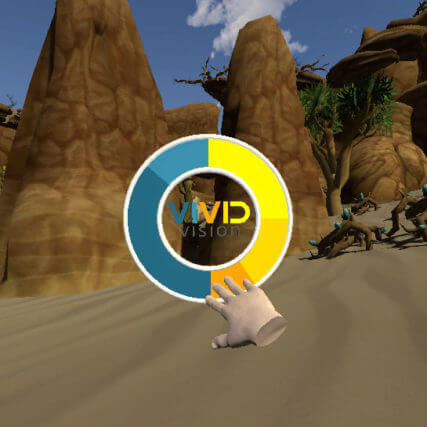
Virtual reality takes Vision Therapy into the future

Highline Center for Vision Performance is proud to now include Vivid Vision, a virtual reality (VR) based therapy, to our digital toolbox. We are currently one of only five vision clinics in the state of Colorado to offer this new technology to our vision therapy patients. Not only is this new tool fun, it’s yielding faster results in many patients.

What is virtual reality?

Virtual reality is a system connecting computers, trackers, and goggles together to create an immersive visual (and sometimes auditory) experience. Small screens are positioned in front of each eye that project images that make it seem like you are moving through a different reality – one in which you can interact. Users hold controllers that allow them to steer through virtual environments and affect specific elements programmed for interaction. You can play games, visit far away places, and learn new skills.

Because binocular vision problems almost always include a reduced or inability to see in 3-D, VR and vision therapy are a perfect match to enhance visual skills.

Vivid Vision changes the game

Vivid Vision is a new software that utilizes VR technology to create customized vision therapy exercises for children and adults with binocular vision problems. Vivid Vision helps train the eyes, brain, and body to all work together. The screens within the goggles project separate images to each eye that the brain fuses into a single image, just like in the real world. That is what provides a sense of depth and motion.

In particular, Vivid Vision supports other vision therapy approaches to treat:

Why is virtual reality important for Vision Therapy?

Vivid Vision is precise and allows our vision therapists to adjust the images projected to each eye independently in order to train specific visual skills. The images can be controlled in terms of brightness and clarity according to specific needs.

Take the Pepper Picker game, for example. When the VR goggles are on, patients see the hand-held controllers as a pair of hands they can move. Pulling the trigger on the controller allows the user to grab items they see in the VR environment. Once in the game, users are standing between several tall plants with big leaves and in front of them is a list of vegetables that they must find by searching through the leaves. The goal is to find the specific vegetables on the list in order and in proper quantities.

Sounds easy, right? Here’s where the game gets high-tech: one eye is being shown the vegetables and the other eye sees only the hands. This forces the eyes to work together to see the whole picture and pick the veggies. Therapists can make small adjustments to various details of the scene in order to challenge each patient uniquely.

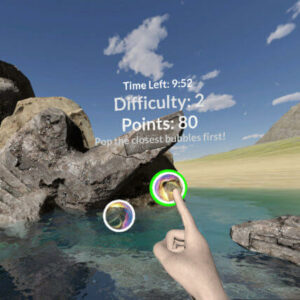
Other exercises challenge depth perception. The Bubbles game challenges users to pop bubbles that appear in front of them by reaching out to touch them with an index finger. The goal is to pop the bubble that is closest to you first. As the game progresses, therapists will gradually move the bubbles closer and closer together so the eyes and brain learn to recognize smaller and smaller deviations in visual depth.

Another game challenges depth perception at distance by asking users to use a squirt gun to hit various carnival targets. The rules require the player to hit targets closest first. As with every exercise, therapists can change details on-the-fly to keep them challenging and advance visual skills development.

Vivid Vision at home

Another exciting opportunity Vivid Vision allows is for *home vision therapy. Most vision therapy appointments take place in our office with a patient working one-on-one with their vision therapist. However, sometimes it is necessary for a vision therapy session to happen remotely and Vivid Vision is a natural fit for distance sessions.

*Highline Center for Vision performance recommends only using the Vivid Vision software under the guidance of a certified vision therapist. Vivid Vision is only one component to our robust vision therapy program that is customized for every patient.

Ready to Schedule An Appointment?

The Highline Vision Center team is looking forward to seeing you soon. Our practice utilizes state-of-the-art technology to deliver personal and comprehensive eye care for your entire family.

Amblyopia: Causes & Treatments

Amblyopia, often called “lazy eye,” is a treatable disorder of vision development that begins during infancy and early childhood. With amblyopia, an otherwise healthy eye is unable to achieve normal visual acuity (20/20) even with glasses or contact lenses. In addition to poor visual acuity, people with amblyopia are more likely to have difficulties with eye-hand coordination, clumsiness, reading, depth perception and understanding what is seen.

In most cases, only one eye is affected but it may occur in both eyes. According to the National Institute of Health, amblyopia is the most common cause of visual impairment among children in the United States and is estimated to affect 3.5% of the US Population, despite being preventable with early diagnosis.

Clues that your child may have amblyopia include crying or fussing when an eye is covered or if the child constantly turns their head to the right or left.

WHAT CAUSES AMBLYOPIA?

There are three types of amblyopia, based on the underlying cause:

  • Strabismic amblyopia:  This is the most common cause of amblyopia. Strabismus is also known as an eye turn. To avoid double vision caused by poorly aligned eyes, the brain ignores the visual input from the misaligned eye and vision fails to develop properly. If you notice your baby or young child has crossed eyes or some other apparent eye misalignment, schedule a comprehensive eye exam immediately.
  • Refractive amblyopia: Amblyopia may be caused by unequal refractive errors in the two eyes, despite perfect eye alignment. For example, one eye may have a significant prescription while the other does not. The brain relies on the eye that has better vision and “tunes out” the blurred vision from the other eye. It can also occur in both eyes when they each have a high uncorrected prescription.
  • Deprivation amblyopia: This is caused by something that obstructs light from entering a baby’s eye, such as a congenital cataract or droopy eyelid (ptosis). Prompt treatment of the obstruction is necessary to allow normal visual development to occur.

Young children with amblyopia rarely have any symptoms. Comprehensive eye examinations are the best way to identify patients with amblyopia or those who are at risk for developing amblyopia. According to the American Optometric Association, children should have their first comprehensive eye exam at 6 months of age.

AMBLYOPIA TREATMENT

In some cases of refractive amblyopia, normal vision may be achieved simply by wearing prescribed glasses or contact lenses. Usually additional treatment is required to stimulate the brain to use the amblyopic eye and enable proper visual development.

Vision therapy is a structured program of activities prescribed to improve visual abilities and acuity. It trains the eyes and brain to work together more effectively and reinforces the connection to the amblyopic eye. During certain activities, the better seeing eye will need to be blurred in order to encourage the brain to pay more attention to the amblyopic eye. This may be done with special fogging patches.

The latest research demonstrates that binocular vision therapy is the most effective long-term solution for amblyopia. Full time patching is rarely the best option for treatment of mild to moderate amblyopia. If patching is indicated, most cases of amblyopia will show improvement with just 2 hours of fogged patching per day in combination with specific visually stimulating activities. For additional resources, please visit www.amblyopiaproject.com.

CHILDREN WILL NOT “OUTGROW” AMBLYOPIA

Amblyopia will not go away if left untreated and can lead to permanent visual problems. An injury or disease in the better seeing eye in the future will leave the person depending on the poor vision in their amblyopic eye, so it is best to treat amblyopia as early as possible.

Modern amblyopia treatments may improve vision in older children and adults, but early detection and treatment is the best chance for normal visual development and optimal visual outcomes.

In addition, best corrected visual acuity of worse than 20/40 in the better eye may require a person to have a restricted driver’s license in Colorado. This could mean a number of restrictions, including no driving at night or during rush hour, no freeway driving, a restricted geographical area the person must stay within and requiring the addition of extra mirrors to the vehicle.

Protect your vision for life! Call Highline Vision Center to schedule a comprehensive eye exam today.

Ready to Schedule An Appointment?

The Highline Vision Center team is looking forward to seeing you soon. Our practice utilizes state-of-the-art technology to deliver personal and comprehensive eye care for your entire family.

Vision Therapy: Weeks Four through Six

We’ve been busy practicing vision therapy at home amongst other things and I’m very excited to share with you that Nolan is making great progress in vision therapy.  Not only are we starting to see changes in how he is progressing through the various exercises, but we are seeing a positive impact in his everyday life.

“Good thing I’m doing vision therapy Daddy, or I would’ve probably knocked that over.”

~Nolan

I mentioned previously that one of the reasons we started vision therapy was because we felt that Nolan was somewhat clumsy, often knocking into things. Nolan’s job after dinner is usually to clear the plates from the table… something that used to make me cringe as I waited for him to drop or knock something over. Well, just the other night, he successfully lifted his plate up and over his sister’s ill-placed glass, and then proudly stated, “Good thing I’m doing vision therapy Daddy, or I would’ve probably knocked that over.”  Yes!  I was so excited not only to see this change but to know that he was seeing it as well.

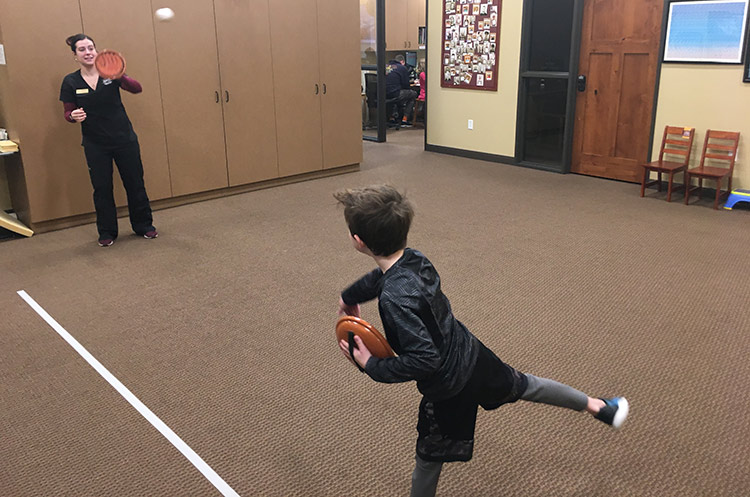
In addition, Nolan surprised me at a recent vision therapy session.  There’s a game that we have called Squap.  It’s basically a catch and throw type game that uses paddles and a ping pong ball.  It’s actually fairly challenging. I was surprised not only that Nolan chose to try it with Ariana, but that he actually was able to catch the ball consistently. Catching is one of the things that Nolan really wanted to improve on, and it’s exciting to see him making progress at things that are important to him.

Progress is important to see. And it’s especially important to us as both parents and optometrists that we help our children not only excel at activities in vision therapy, but that we help them to translate those things into everyday life. Seeing these improvements helps us and our patients gain the motivation to continue working hard to get the best results possible!

Nolan plays Squap with Ariana.

Ready to Schedule An Appointment?

The Highline Vision Center team is looking forward to seeing you soon. Our practice utilizes state-of-the-art technology to deliver personal and comprehensive eye care for your entire family.
Vision Therapy Triumph: Elliot

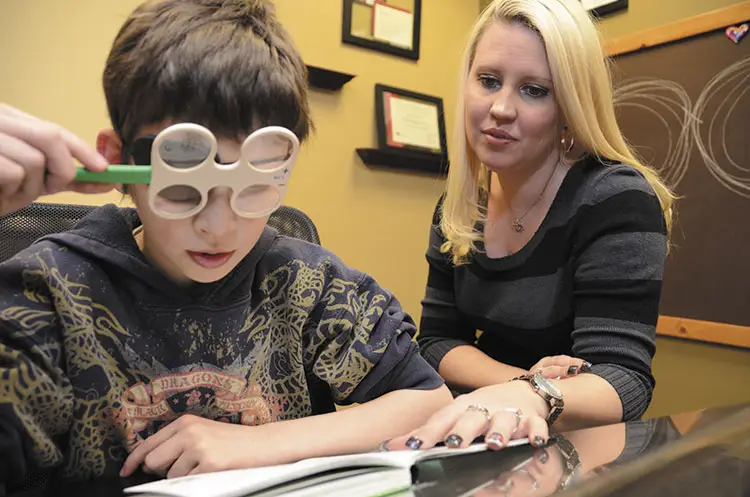
Elliot, like many students, thought that his classroom struggles could be overcome by hard work alone. As a senior in high school he received a Vision and Learning Screening as recommended by Dr. Doyle, his Highline optometrist. He was then able to understand just how adversely his visual skills affected his learning. The screening revealed his reading comprehension was just 30 percent.

Reading is one of the most challenging aspects of education for school-aged children. It’s also one of the most important considering some amount of reading is required in nearly all subjects. Add a vision deficiency and reading can become an extremely anxiety-inducing part of the school equation.

For Elliot, reading was a struggle for most of his school life. When he read, Elliot would find himself going back over the same lines of text multiple times.

“I would read the first three words or so and then go back,” he recalls. “I was having to read words over and over in order for them to make sense.” Elliot

In 2012, when Elliot was in the 8th grade, his Highline eye doctor prescribed Vision Therapy but, at the time, he and his parents were not convinced his problems learning were related to his vision. Most tasks would take him considerably longer than they should. He was also performing poorly on tests.

“It was frustrating because I would study for tests and my mom would quiz me and I would do great,” he says. “I understood the material but when it came time to take the test, the questions I was reading wouldn’t make sense.”

It wasn’t until the beginning of his senior year, in 2018, that Elliot and his mom decided it was time to do something about his vision to address the problems he was having with reading and comprehension. At that time he had developed headaches when reading.

Taking Action

Nancy Stevens worked with Elliot as his vision therapist.

Elliot’s optometrist, Dr. Nick Doyle, prescribed glasses and a course of Vision Therapy. Vision Therapy works to enhance the eye/brain connection. When visual efficiency and comfort are optimal, students can comprehend information faster and work on tasks longer and more comfortably.

In Elliot’s case, a Vision and Learning Screening from Highline Center for Vision Performance revealed that his eyes were not converging properly. Because of poor convergence, also referred to as eye teaming or binocular vision, his reading comprehension was adversely impacted. Convergence is just one of the 20 vision skills that can impact overall vision performance.

When Elliot first began Vision Therapy, his reading speed was 216 words per minute. But after just eight weeks of his prescribed therapy, that jumped to 400 words per minute.

Upon completion of 14 weeks of vision therapy, Elliot had made major improvements in his reading speed and comprehension and his headaches resolved.

Eliot’s reading comprehension jumped to upwards of 80 percent within his first eight weeks of therapy. In addition to weekly sessions, where he would work with a Highline Center for Vision Performance therapist, Elliot would also have at-home assignments to reinforce the therapeutic benefits and make skills automatic.

Nancy Stevens, Elliot’s vision therapist says, “I was so impressed by how committed Elliot was to his home Vision Therapy practice. At only eight weeks, his visagraph tests revealed his reading speed had jumped from severely reduced to 12th grade level! These dramatic changes can only come when the patient, parent and vision therapist work as a team.”

Building Confidence

Ultimately, Elliot says Vision Therapy has had a major positive impact on his level of confidence, thanks to a higher level of classroom success and improved grades in all of his courses. Whereas homework and test taking were once a source of anxiety, he says he’s now back to enjoying learning and setting his sights on college.

“Before I felt stressed out about how fast I finished the test, but now it doesn’t take me more than one try to read the questions,” he says. “I feel more calm during tests because I can read a question and understand and comprehend it.”

What’s more is that Elliot says Vision Therapy also helped him excel at the sports he loves. He’s been involved in both football and basketball since he was in grade school.

“Overall, I feel more confident in basketball and football — my eye/hand coordination has definitely improved,” he says. “This is real, and it helped change my life.”

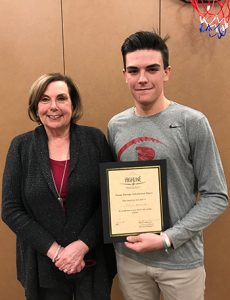
“We are so proud of Elliot and his success,” Nancy says. “He has already reaped the rewards of his hard work by recently being accepted to CSU. He even wrote a college essay about how Vision Therapy had helped him. His story brings me so much joy and I know his future is brighter now that he can learn more easily!”

If your child is struggling in academics or sports contact Highline Center for Vision Performance today for a complimentary Vision and Learning Screening.

Ready to Schedule An Appointment?

The Highline Vision Center team is looking forward to seeing you soon. Our practice utilizes state-of-the-art technology to deliver personal and comprehensive eye care for your entire family.

Brandon Belt, San Francisco Giants First Baseman, Speaks About Vision Therapy

Video courtesy of Carole L. Hong, OD, FCOVD: In this video, San Francisco Giants first baseman, Brandon Belt, discusses how vision therapy helped him recover from concussions even though he had “perfect vision.” Even now, he continues to go to vision therapy and he thinks vision therapy is “the next level of the game.”

Voice of Carole L. Hong, OD, FCOVD: Brandon, I know you’ve been quoted as saying like “If I can see it, I can hit it,” and I know that vision therapy was a part of your journey. Can you tell us a little bit about that and any vision symptoms that you had prior…

Brandon Belt: Yes, so, I basically have perfect vision. I mean, I can see really well. Like, I don’t know. Like, superhuman vision. <laughter> So, I mean. And, I say that for a reason too. Because, and I think a lot of athletes are like that. So, when the smallest thing is off, we notice it.

And, you know, it’s not, I mean this is a couple of different ways that it affects you. I mean sometimes it’s double vision. Sometimes something’s blurry. Sometimes everything just slowed down and your eyes aren’t moving as quickly as you want them to. So, I think that’s what I meant by saying what I said.

But, that also brings the most stress too, because in baseball, your eyes are everything. You’ve got to have them working perfectly, and when it doesn’t come back quickly, man, that brings on a lot of anxiety, and that’s one of the biggest problems I have, and after the last two concussions I went to vision therapy and I did that for a couple months.

I did it [vision therapy] during the off season because that’s just when my concussions fell – I was able to do it in the off season. So I did in the 4 months of the off season, and I came back and had both years, pretty much, had all star seasons.

So, one was in 2016 and one was before last season, and I was having one of my best years to date last year before I had the surgery. So, the thing I learned from that was vision therapy is pretty important whether you have a concussion or not.

So, I didn’t have a concussion this year, but I’ve been going back. And, I think that’s probably, I might be getting off on a tangent here, but that is probably the next phase of the game. That, to me, people are really going to acknowledge and say, “Hey, we gotta get better at this if we want to be better baseball players, if we want to be better athletes.”

So, I’ve been going back and doing that, and it’s just so important to our craft and to our sport. That it means everything, and that why I said that and why it’s so important to me at the time.

Ready to Schedule An Appointment?

The Highline Vision Center team is looking forward to seeing you soon. Our practice utilizes state-of-the-art technology to deliver personal and comprehensive eye care for your entire family.
Vision Therapy: Week Three

As I mentioned in a previous blog, I see kids on a regular basis who have binocular vision or eye tracking efficiency deficits. Usually, the process of explaining this is fairly straightforward. We sometimes show parents examples of activities that their children are struggling with, we go through certain test results with them and compare them against normal values, etc. But when my six-year-old son, Nolan, asked me the other night why he had to do his vision therapy homework I felt somewhat ill-prepared….

“I had to make it important to him, getting him to buy in to doing months of practice at home with me.”

Dr. Nick Doyle, Optometrist

Nolan practicing saccade – a very fast eye movement exercise.

At that moment, I realized that I’d never really had to fully explain this to someone as young as he was.  Sure, we explain things like this to patients all the time, but usually we talk more directly to some of our older kids and teenaged patients. Nolan proceeded to tell me that he could “see everything clearly” and that his “eyes were fine” …all while he was protesting starting his vision therapy home practice of course.

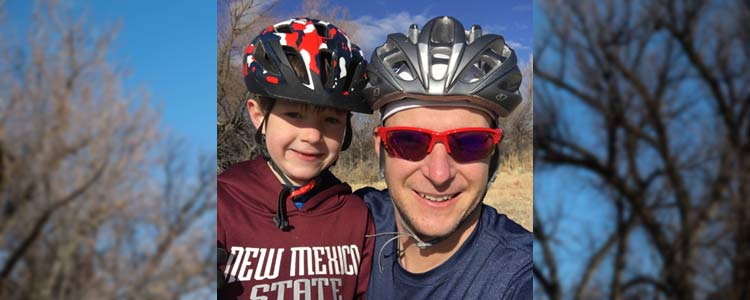
And he wasn’t wrong.  He CAN see things clearly.  He doesn’t need glasses, and in fact, glasses won’t help with what we’re trying to accomplish anyway.  Unfortunately, he’s too smart for me to give him the tired old generic parent response of “because I said so.”  I knew that I needed to craft my response in a manner that would help him to see the benefit.  I had to make it important to him, getting him to buy in to doing months of practice at home with me.  I thought about some of the things that he’d mentioned in the past… how he didn’t want to play baseball because he thought he wasn’t good at catching, how he loves riding his bike, and how the thing he was most excited about when he started school was learning to read.

I began to tell him how practicing vision therapy would help him to learn to catch and throw the baseball better, how he’d be able to ride his bike more confidently on the path and know where to turn (he sometimes has trouble with staying on the right side too), and how it would help him to become an even better reader.  I explained to him that his eyes not only have to see things clearly, but they have to move like a team, just like all of the other parts of his body. Thankfully, Ariana reinforced this at his vision therapy session by telling him that his eyes have to tell his brain to tell his body where to move.

And so seemingly, for now at least, I had his attention.  Since that conversation, I’ve had good cooperation getting his home practice started, even after a long day of school.  We always tell patients that we don’t want vision therapy to become a burden to them, especially during the school year, and believe me, I know how hard it is to try and grab the attention of a child after a full day of school when his brain is just done paying attention for the day.  As parents (and optometrists) we have to come up with better ways to get our children and patients to see value in what we’re providing, whether that means talking about things they’d like to improve on, inventing incentive systems, etc.  In the age of instant gratification, this can be less than easy. But the lessons learned by continuing to work toward a goal can be invaluable… both for a visual system, and a developing young mind.

Ready to Schedule An Appointment?

The Highline Vision Center team is looking forward to seeing you soon. Our practice utilizes state-of-the-art technology to deliver personal and comprehensive eye care for your entire family.
Vision Therapy: Week One

It was a snowy and cold Saturday morning when Nolan and I headed to the office for his first session of vision therapy.  I knew what to expect as we walked into the office, but my inquisitive six-year-old was curious about what lay ahead of him for the next forty-five minutes.  I began to tell him a little bit about what he would learn in vision therapy and that a lot of the things he would do would be fun like games.  This seemed to pique his interest even more.

Meeting Our Vision Therapist

Nolan was excited to meet his vision therapist, Ariana, and you could tell immediately that they were going to work well together.  Ariana was quick to remind me that usually they like to have parents in for the last ten to fifteen minutes of the session so that they can go over home practice activities.  So, I did the thing I’m most uncomfortable doing… I waited.  (My whole staff will tell you that I’m likely the most impatient person they’ve ever met.)

Nolan at his first week in Vision Therapy with Ariana, his Vision Therapist.

When it was time for me to come back to see how Nolan had been doing, he had a big smile on his face. He was proud to show me all of the activities that he had worked on, especially the ones that we’d be working on at home.

Ariana explained that we’d be working a lot on eye tracking activities for the first week since this really is a foundation of how our eyes work together.  She did a fantastic job of explaining what activities we would be working on for the week, giving us a sheet with all of them clearly listed.  I’d seen this before obviously, but I have to tell you that from a parent’s perspective, I really like how it has a spot to indicate how hard (or easy) a particular activity is each time you practice it.  This really helps our vision therapists know when it’s time to provide additional help or when they need to bump up the difficulty on certain things.

And that’s that.  We were off with our bag of home practice supplies and armed with a binder full of activities for the week.  I was both excited and nervous.  I’m anxious to get started with helping Nolan out, and also nervous about how I’m actually going to keep him engaged at home.  More on that and on how our home practice is progressing soon!

Ready to Schedule An Appointment?

The Highline Vision Center team is looking forward to seeing you soon. Our practice utilizes state-of-the-art technology to deliver personal and comprehensive eye care for your entire family.
Vision Therapy for an Optometrist’s Son

Writing this blog post is a humbling moment in my career. As I write, I feel like a terrible father and optometrist but I will keep writing in the hopes my family’s journey will help others.

All day I see patients and discuss, in great detail, the visual or physical symptoms they experience that affect their enjoyment of life as well as their continued health. I, and the other doctors here at Highline, are especially passionate about targeting potential visual skills deficiencies that can keep kids and adults from learning efficiently. For some people, these binocular vision issues can cause some pretty debilitating physical symptoms like eyestrain, headaches, and double vision.  For others, the cues are often subtler and are easily missed or written off as other things like “boyishness”.

We are passionate about helping people properly develop these visual skills because not doing so limits their potential. When learning is especially difficult or hurts, kids don’t want to succeed in school, they just want to survive and graduate high school. And they definitely don’t want to go to college to pursue an interest that might otherwise feed their soul. When near work hurts or is difficult for adults, they adapt to their existing capabilities and change their career goals to match what they can do comfortably. In short, when learning is difficult or painful, the future becomes more limited than it should be and that’s just not okay.

What I Missed: The Signs

Which brings me back to why I feel like a terrible father: I overlooked some signs that my son had a visual skills deficiency and needed Vision Therapy.

Now, to be fair to myself and my wife, our son, Nolan, is six years old and this is about the age we, as optometrists, are able to spot visual deficiencies in our young patients. It’s when kids begin learning in a school environment that visual issues often present themselves. In our case, Nolan was learning in the classroom just fine and his reading skills are progressing at above his age level. In addition, some of his processing skills seem very advanced (Can I tell you that he’s building Lego sets intended for 16 year olds?). But, here’s what we started noticing:

  • He was a bit clumsy: it’s as if he had trouble recognizing how his body moved in relation to his surroundings.
  • He was fidgety when doing homework: he squirmed in his seat and picked at his clothing and otherwise, would not sit still.
  • He has always avoided team sports: fearing that he “won’t be any good.”

After some discussions with my wife, we decided to just pull the trigger and put Nolan in Vision Therapy right now. The worst thing that could happen would be that – as his eyes and brain are trained to work together at a higher level – he might need more advanced Lego sets!

Some of the visual skills I had checked with Nolan at his exams actually didn’t look too reduced, but I knew that we often get a lot more information after scheduling a screening appointment in the Vision Therapy office.  It was at this first Vision Therapy appointment that our suspicions were confirmed: Nolan’s eye tracking skills were very underdeveloped.  He seemed to have trouble with some basic visually guided motor skills, and I was astonished at the effort that some of the testing took for him.

Here We Go!

So here we are, beginning Vision Therapy and it is my intention to bring you along with us so you can see what Vision Therapy is like from a parent’s perspective. Follow Highline Vision Center on Facebook or Instagram to see when this blog is updated.

Ready to Schedule An Appointment?

The Highline Vision Center team is looking forward to seeing you soon. Our practice utilizes state-of-the-art technology to deliver personal and comprehensive eye care for your entire family.